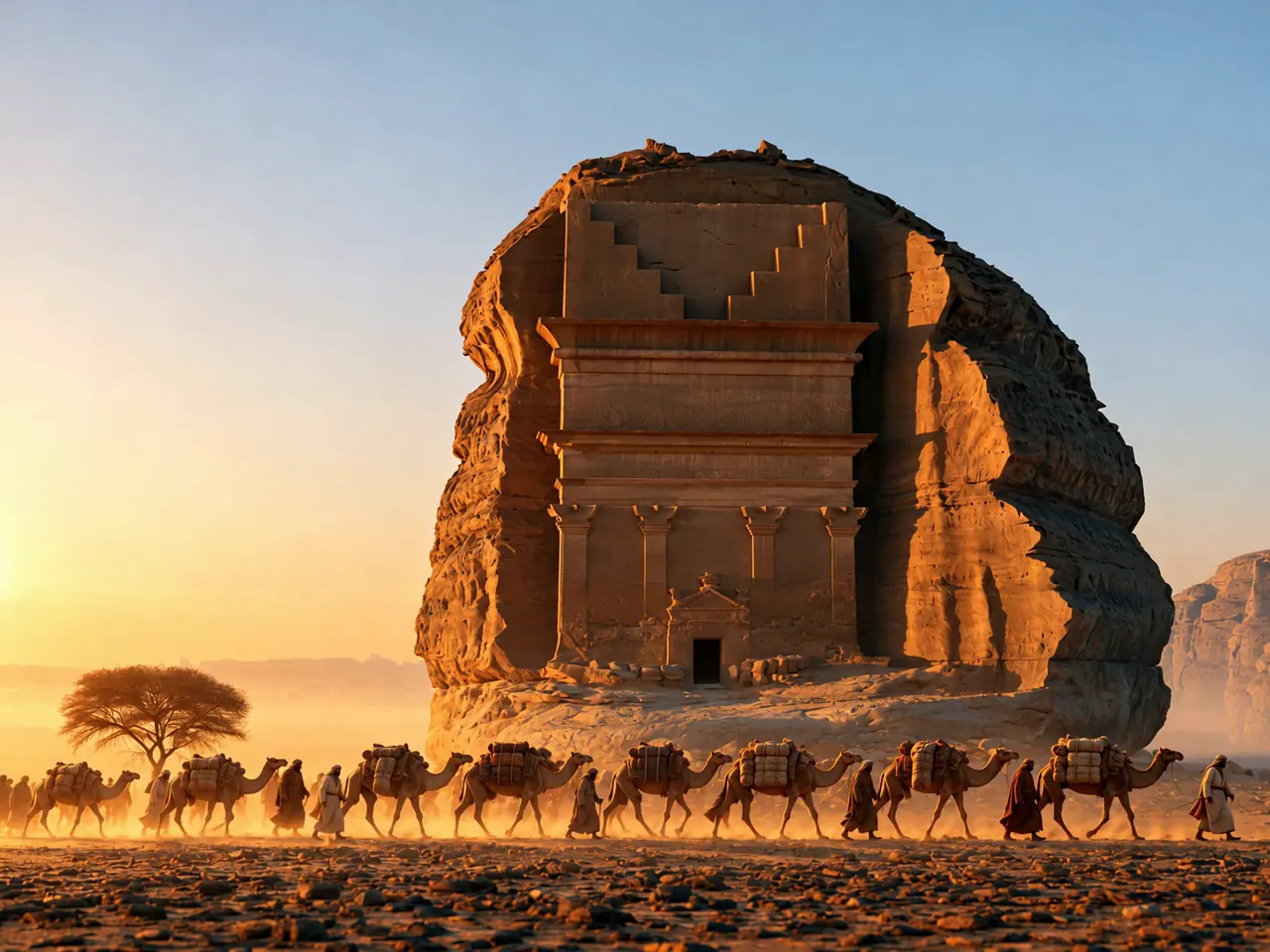
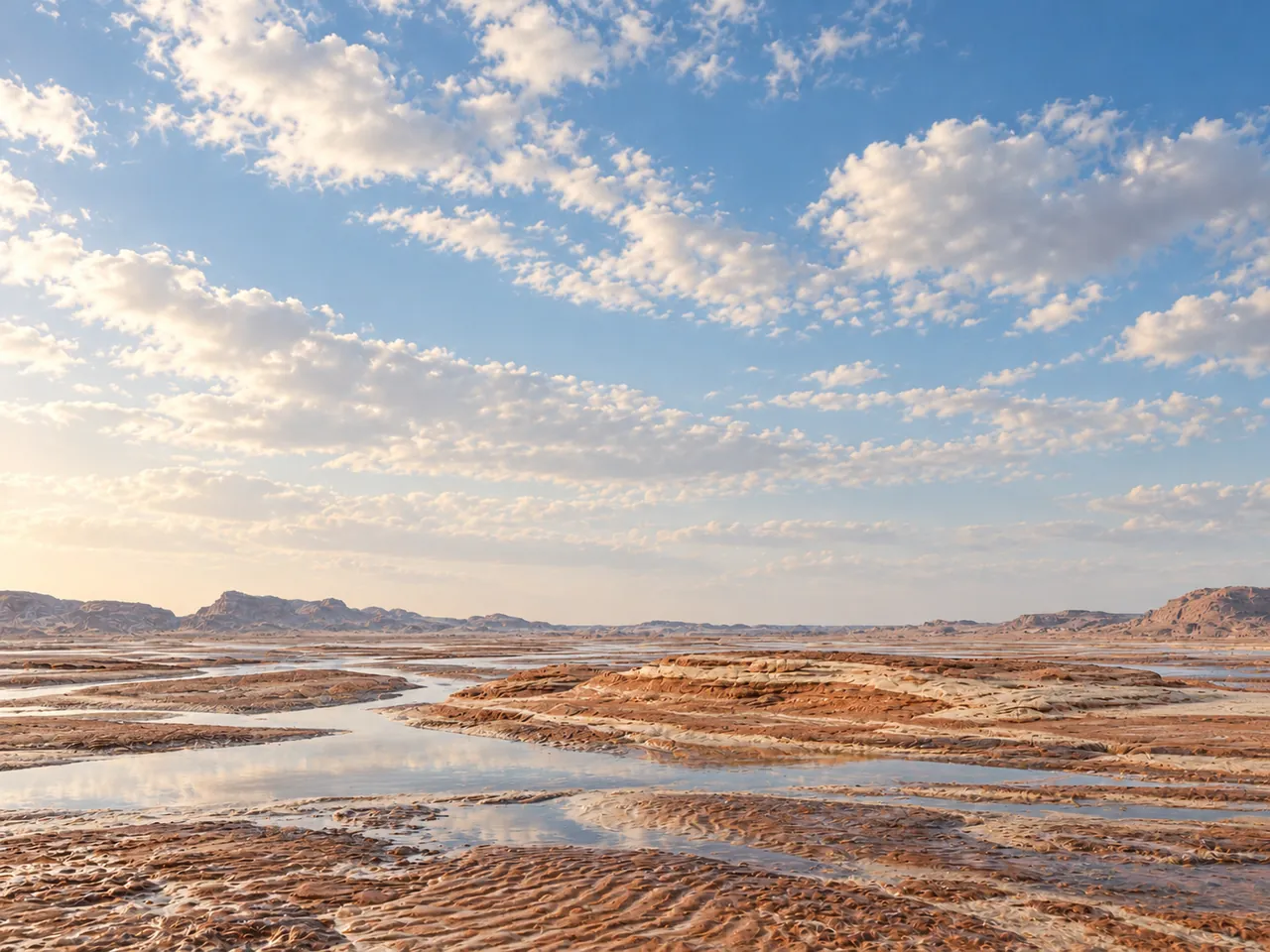
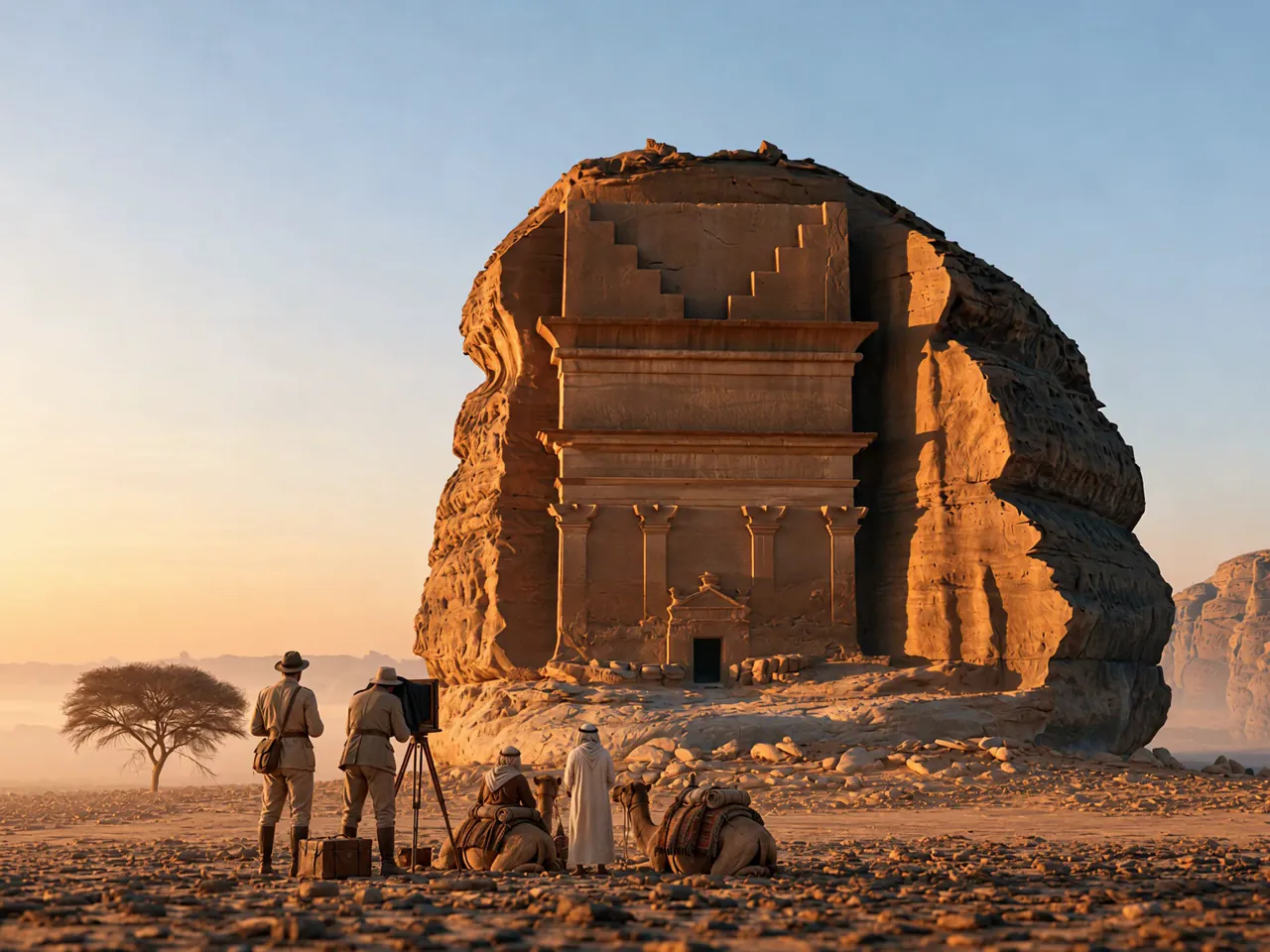
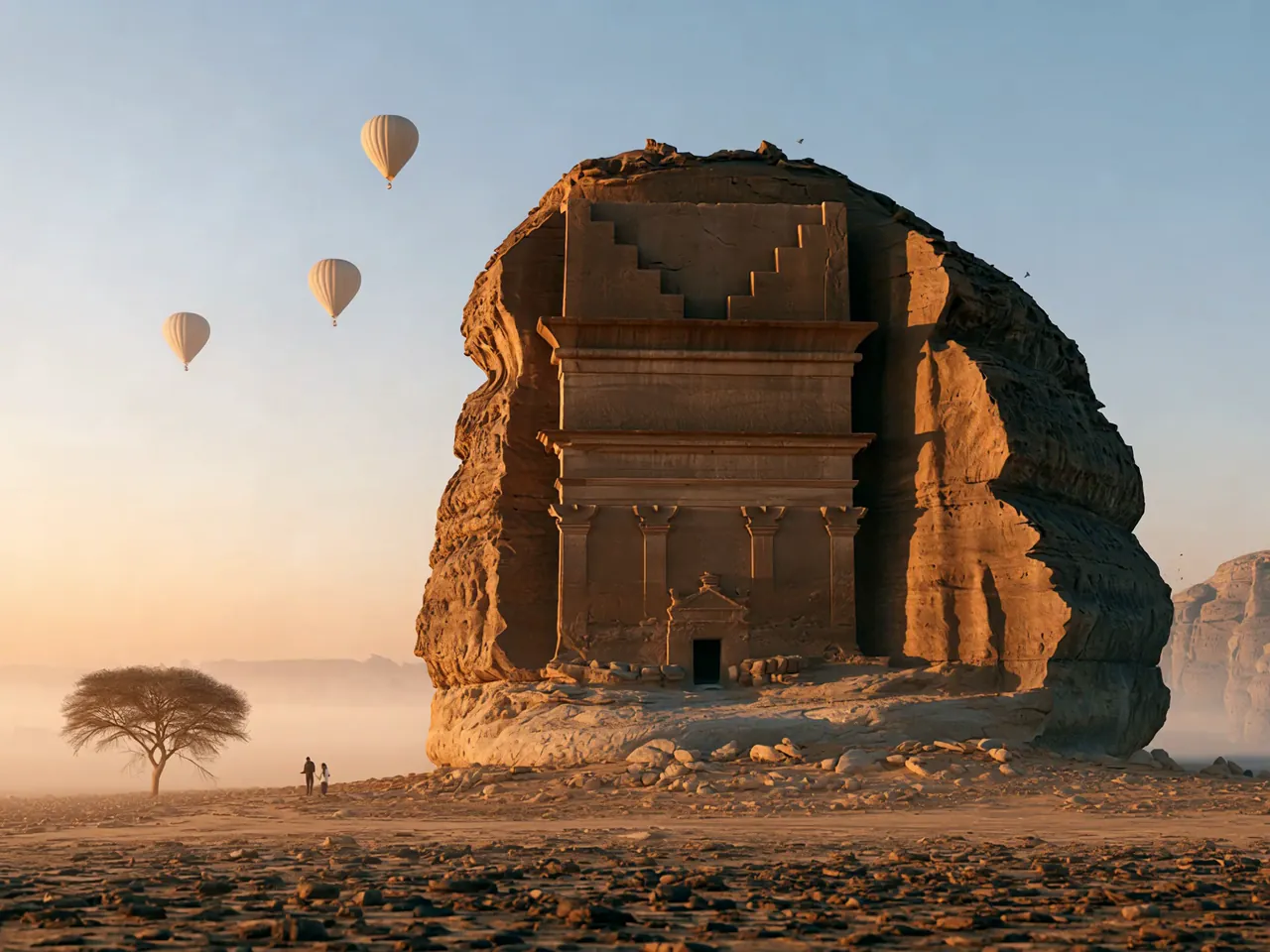
One rock at Hegra was once sand in an ancient river, then the shore of a sea where long-extinct creatures crawled, then a seabed where it hardened into stone. It saw the land green, heard the chisels of the Nabataeans, waited for the caravans and knew centuries of silence, until the travellers raised their cameras before it. Today it welcomes visitors. Move time with your own hand, and watch it age after age.
Drag the handle along the timeline to travel the ages yourself, or tap any age.
In numbers
About 500 million years
The age of the sandstone the tombs of Hegra are cut into, from the Cambrian and Ordovician. Hegra: history
23 metres
The height of the lone rock Qasr al-Farid is carved into; it is about 18 metres wide. Hegra Conservation
111 tombs
Cut into the rock at Hegra, 94 of them with decorated façades. UNESCO
2008
Hegra became Saudi Arabia's first World Heritage Site. UNESCO
What you will find here
How we made this
The scenes are AI-generated: one image for each age, then morphs between them. They are an artistic visualisation, not a record; the people in them are imagined and do not depict real individuals.
Some scenes show the façade complete for the sake of the story; in reality its lower part was never finished.
The “Be there” scenes imagine what the sources describe through the eyes of a visitor standing in the place; their tomb interiors follow what studies describe for the tombs of Hegra, not the inside of Qasr al-Farid itself.
The facts come from published sources, all listed below, and we correct anything found to be wrong.
Every image and clip on this page is listed in our signed provenance registry, so you can verify any file.
I was not yet a rock, only sand, carried by shallow, braided rivers across a plain that ran past the edge of sight. No grass, no trees: the land had not yet known a single plant. Grain by grain the sand settled here, where I stand today, layer upon layer.
The rock says
On the record
The sandstone of Hegra dates from the Cambrian and Ordovician, roughly half a billion years ago: its Cambrian layers are reddish-brown, its Ordovician ones lighter. Hegra: history
The Cambrian ran from about 541 to 485 million years ago, and there were no plants or animals on land. Britannica
With no roots to hold their banks, rivers ran wide and shallow, almost like spreading floods. Geologists say there is probably nowhere on Earth today where rivers form the way they did before plants. American Scientist
2About 465 million years ago
The ancient sea of AlUla
Then the sea crept in and covered me. I became a shallow shore, battered by storms season after season, and over my sand crawled creatures with crescent-shaped shields. The storms flung them onto their backs; they struggled to turn over, and the sand buried them before they could. They stayed in the stone just as they fell, until researchers found them not far from me, in the AlGharameel reserve.
The rock says
On the record
Fossil horseshoe crabs about 465 million years old, from the Middle Ordovician, were found in AlUla’s AlGharameel reserve and announced in January 2026. OkazGondwana Research 2026
All of them were preserved upside down, a mode of preservation never recorded before. The researchers think fierce seasonal storms carried them out of the shallows and dropped them on their backs, and the rock also kept traces of their attempts to turn back over. OkazGondwana Research 2026
The largest head shield is about eight and a half centimetres wide, unusually large for horseshoe crabs of that age; the species has not yet been classified. Gondwana Research 2026
The rocks that hold them formed in a tide-influenced delta, and climate models put the sea-surface temperature at roughly 16 to 23 °C. Gondwana Research 2026
The first dinosaur bones found in Saudi Arabia came from the coast of Midyan and are about 72 to 75 million years old, so the AlUla crabs are some 390 million years older. PLOS ONE 2013
3About 460 million years ago
Beneath the sea of AlUla
Then the sea deepened over me. Its floor became home to armoured creatures crawling across the mud, and to long cone-shelled animals swimming above them. From above, mud and sand kept raining down, layer upon layer, burying the sands I had been deeper and deeper. Down there, under the weight of the water and everything on top, my grains hardened into stone.
The rock says
On the record
Above the Saq sandstone of Saudi Arabia lies the Hanadir formation, and the top of the Saq itself is full of traces left by trilobites crawling over the seabed. Geological Magazine 1988
The Hanadir has yielded trilobites of several kinds, with graptolites, brachiopods, bivalves, ostracods and straight-shelled nautiloids: a fauna of the kind that lived around the great southern continent of Gondwana. Palaeontology 1985
Trilobites were exclusively marine animals. They appeared about 521 million years ago, and the last of them lived in the Permian, which ended about 252 million years ago. Britannica
Sand buried under thick layers is packed and cemented into sandstone, which erosion later lays bare once the land has risen. Hegra: history
4Thousands of years ago
When the land was green
Then the sea drew back from me, stone by now. Water and wind slowly carried away everything above and around me, until I stood alone. When the skies grew generous over Arabia, the land around me turned green, and herders brought their cattle to the water at my feet.
The rock says
On the record
The rock did not rise out of the ground; it is what remained when everything around it wore away. Hegra’s landscape is one of isolated Palaeozoic sandstone outcrops, shaped by intense erosion in the late Miocene, some 11 to 5 million years ago. Hegra: history
In the Neolithic, north-west Arabia was significantly greener than it is today. Its people built mustatils there: more than 1,600 ritual stone structures spread over about 300,000 square kilometres; one excavated example is about 7,000 years old, and horns of cattle, goats and gazelles were found in their chambers. Arab News
5Early 1st century AD
The first chisel strike
Then came men with axes, picks and chisels. They did not start from the ground; they climbed to my top, carved the crown first, then came down line by line. Every morning I heard the chisel, and watched my face change.
The rock says
On the record
The Nabataeans carved their tomb façades from the top down, as the Saudi-French excavations at Hegra have shown. CNRS
Qasr al-Farid is recorded as IGN 110, the Tomb of Lihyan son of Kuza, and is dated to about AD 0 to 30. Hegra Conservation
It was cut with the axe, the pick, the point chisel and the flat chisel; their strokes still show on the rock, above all in low sunlight. Hegra Conservation
61st century AD
On the incense road
Now I had a face and a door, and above the door a single line. Caravans passed me heavy with frankincense and myrrh, on their way from the south of Arabia to the ports of the Mediterranean. The merchants looked up at me and moved on; few of them knew for whom I was carved.
The rock says
On the record
Hegra is the largest preserved Nabataean site south of Petra, and was a station on the caravan routes linking Arabia with the Mediterranean world and Asia. UNESCO
Hegra has 111 monumental tombs, 94 of them with decorated façades blending Assyrian, Egyptian, Phoenician and Hellenistic influences. UNESCO
Qasr al-Farid bears a one-line inscription that John Healey read two ways: "For Hayyan son of Kuza and his descendants", or "Lihyan son of Kuza took possession of it". Laïla Nehmé suggests the tomb changed hands before its first owner could inscribe his name. Hegra Conservation
The façade was never finished: the bases of the four pilasters and the doorway decoration were left incomplete. Hegra Conservation
7After the caravans
Centuries of silence
Then the road drew away from me. Ships carried what camels once carried, and the city slowly emptied. I was left with the night, the stars and the foxes. But writing did not die here: in the year 267 a son carved lines on his mother's tomb that some scholars see as the oldest dated Arabic text.
The rock says
On the record
Rome annexed the Nabataean kingdom in AD 106; a Roman legion kept a garrison at Hegra in the 2nd century, and stayed until at least the end of the 3rd. Hegra: historyArab News
Trade turned from the overland road to the Red Sea routes, and the city lost all its urban functions by the beginning of late antiquity, mainly, experts believe, because of desertification. Hegra: history
The epitaph of Raqush daughter of Abd-Manat, dated to the month of Tammuz in AD 267, is written in Nabataean letters in a language close to Arabic. Healey and Smith hailed it as the earliest dated Arabic document; others classify it as Nabataean. Healey and Smith 1989
For centuries the road remained a pilgrim route, and a fort was built at Hegra between 1744 and 1757 on the orders of the Ottoman governor of Damascus, As'ad Pasha al-Azm, to protect them. Hegra: history
AlUla's skies are among the darkest in the region: its Manara and AlGharameel reserves became the first International Dark Sky Park in Saudi Arabia and the GCC. DarkSky
8Early 20th century
The travellers' lens
Centuries later, men came from far away. They carried no chisels, only notebooks and black boxes they hid beneath. They stood before me a long time, copied the writing on the rock, and carried my picture into the books of the world.
The rock says
On the record
The English traveller Charles Doughty reached Hegra in 1876 with the pilgrim caravan, studied its monuments and inscriptions, and published his journey in 1888. Britannica
The Dominican fathers Antonin Jaussen and Raphaël Savignac explored AlUla and Hegra in 1907, 1909 and 1910, photographing the tombs and copying their inscriptions for Mission archéologique en Arabie (1909 to 1914). The Raqush inscription is number 17 in their catalogue. École biblique
The Hejaz Railway passed by Hegra, with a station just to its north, until the line was wrecked during the First World War. Hegra: history
92026
Today
Today people come to me from everywhere. They do not want to carve me or take anything away; they want to stand a while and listen. My name is Qasr al-Farid: one rock, with all these ages in its face.
The rock says
On the record
In 2008 Hegra became Saudi Arabia's first UNESCO World Heritage Site, as the largest preserved Nabataean site south of Petra. UNESCO
The Royal Commission for AlUla is documenting and conserving its tombs, one by one. Hegra Conservation
And in the skies over AlUla, balloons rise during the AlUla Skies festival. Experience AlUla
The scene
Look closer
Tap any circle in the scene, or any item below, to see it up close and read what is known about it.
When the rock was sand · About 500 million years ago
The ancient sea of AlUla · About 465 million years ago
Beneath the sea of AlUla · About 460 million years ago
When the land was green · Thousands of years ago
The first chisel strike · Early 1st century AD
On the incense road · 1st century AD
Centuries of silence · After the caravans
The travellers' lens · Early 20th century
Today · 2026
Be there
When the rock was sand · About 500 million years ago
Stand on the sand
You are standing on a plain of wet sand, about half a billion years ago. Under your feet are ripples drawn by water; ahead, shallow channels split and rejoin all the way to the horizon. Look around: no grass, no tree, no bird, and no footprint but yours.
What we know
In the Cambrian there were no plants or animals on land. Britannica
Before plants, rivers were wide and shallow, almost like spreading floods. American Scientist
The scene is an artistic visualisation of what these sources describe.
The ancient sea of AlUla · About 465 million years ago
Stand on the shore
You are standing on a shallow shore just after a storm. Waves wash the sand at your feet, and around you are horseshoe crabs: some crawling, some on their backs, struggling to turn over.
What we know
Every fossil found in AlUla’s AlGharameel reserve lies upside down, a mode of preservation never recorded before. Okaz
The researchers think large storms carried them out of the shallows and dropped them on their backs, and they suffocated trying to escape. Gondwana Research 2026
The creatures in the scene are an artistic reconstruction: the fossils do not keep every detail, and the species has not yet been classified.
Beneath the sea of AlUla · About 460 million years ago
Dive to the seabed
You are floating above an ancient seabed, with light falling from the surface far above. Trilobites crawl across the mud ahead of you, and in the blue depth a nautiloid passes in its long shell. Here, under this water, the layers that will one day become stone are piling up.
What we know
The Hanadir beds of Saudi Arabia have yielded trilobites, with straight-shelled nautiloids and brachiopods. Palaeontology 1985
The creatures are an artistic reconstruction, and the fossils cited come from other sites in Saudi Arabia, not from AlUla itself.
When the land was green · Thousands of years ago
Stand at the foot of the rock
You have come close enough to touch the stone. Look at its red and pale layers, and the hollows that wind and salt have dug into it like a honeycomb. Beside you, cattle drink at a pool, in an Arabia that was once far greener.
What we know
Some layers of Hegra’s sandstone are heavily affected by wind erosion and salt crystallisation. Hegra: history
In the Neolithic, north-west Arabia was significantly greener than it is today. Arab News
The water and the cattle are an artistic visualisation of that time.
The first chisel strike · Early 1st century AD
Stand beneath the carvers
You are at the foot of the rock while the work goes on above you. The crown is already finished at the top; the carvers come down line by line, dust falls with every blow, and whatever they cut away piles up as rubble at your feet.
What we know
The Nabataeans carved their tomb façades from the top down. CNRS
Qasr al-Farid was cut with the axe, the pick, the point chisel and the flat chisel. Hegra Conservation
The ladders and ropes imagine how the carvers reached the top; the sources do not describe the scaffolding.
On the incense road · 1st century AD
Step inside the tomb
You have stepped through the door: daylight behind you, a silent chamber ahead. Plain walls with no ornament, burial recesses cut into them, graves cut into the floor, and in one recess a body wrapped in cloth and leather.
What we know
Inside, the tombs of Hegra are severe and plain, unlike their decorated façades: family burial chambers with graves cut into the walls or the floor, added over generations. Hegra: history
In tomb IGN 117 one of the dead was wrapped in layers of plain-weave fabric and an outer layer of leather; a mixture of vegetable oil and resin among the fabrics preserved the body, and the person wore a necklace of dates. Google Arts & Culture
This is the inside of a Nabataean tomb as studies of Hegra describe it, not of Qasr al-Farid itself: published sources do not describe its interior, and Arab News reports no sign of burial places inside. Today it cannot be entered. Arab News 2020Saudipedia
Centuries of silence · After the caravans
The tomb at night
Centuries have passed with the door open to the wind. Sand has drifted in, covering the floor and filling the graves; moonlight draws a rectangle at the threshold, crossed by the tracks of a passing fox.
What we know
The city lost all its urban functions by the beginning of late antiquity, mainly, experts believe, because of desertification. Hegra: history
The scene imagines a Nabataean tomb after it was abandoned, not the inside of Qasr al-Farid itself.
The travellers' lens · Early 20th century
Step in with the travellers
The early 20th century. The sun is behind you, and your shadow stretches across the chamber floor. Sand and fallen stone cover the ground, and the recesses in the walls are empty. This is how the travellers stood in the doorways, photographing and noting what they saw.
What we know
Fathers Jaussen and Savignac visited Hegra in 1907, 1909 and 1910, photographing the tombs and copying their inscriptions. École biblique
The scene imagines a Nabataean tomb, not the inside of Qasr al-Farid itself.
Today · 2026
Stand where visitors stand
You are at the barrier in front of Qasr al-Farid, and the rock rises some twenty-three metres before you. Its door, four metres above the ground, stays dark and nobody goes in: today, visits are limited to standing outside.
What we know
Visits to Qasr al-Farid are limited to viewing it from outside; visitors are not allowed to enter. Saudipedia
The rock rises about 23 metres, and the entrance to the burial chamber sits about four metres above the ground. Hegra Conservation
Tool
Carve it the Nabataean way
Drag your finger or the pointer over the rock to carve the façade. But remember: the Nabataeans began at the top. CNRS
When you reach the pilaster bases you will stop where the carvers of Qasr al-Farid stopped some two thousand years ago.
0% carved
Tool
From Nabataean to Arabic
The Nabataean alphabet has twenty-two letters, and it is the ancestor of the Arabic script. Between the 3rd and 6th centuries AD it gradually became the letters Arabic is written in today. Pick a letter to see its Nabataean ancestor. CNRSArabic alphabet
Arabic inherited it from the Nabataean alphabet. CNRS
Your name in Nabataean letters:
Each letter is written in the Nabataean shape it developed from, without dots or vowel marks, as the Nabataeans wrote, and letters that had a word-final form take it at the end of a word.
Tool
Take the picture they took
Move the camera frame over the scene and press Take. Your picture comes out as a print, the way expedition photographs did in the early 20th century.
Tool
Compare two ages
The rock stands in the same place in every scene. Drag the divider to see what changed and what stayed.
From
To
Tool
The rock's clock
If we squeezed this rock's age, about half a billion years, into a single day, when would people arrive?
Moments in the rock's day
Everything we know of people around this rock, from the mustatils to the latest visitor, happened in the last two seconds of its day.
A Balad Bytes service
Your place has a story through the ages
A museum, a heritage site, or a city that wants to tell its history? We build experiences like this one: a single scene that travels through the ages, with verified facts and named sources, in Arabic and English.
One cinematic scene that travels through the ages, made for your place.
Chapters in the voice of the place, with verified facts, each with a named source.
Interactive tools that serve the story of the place itself, not games bolted on.
Arabic and English, on phones and on museum screens.
Every image and clip labelled as AI-made and listed in a signed provenance registry.